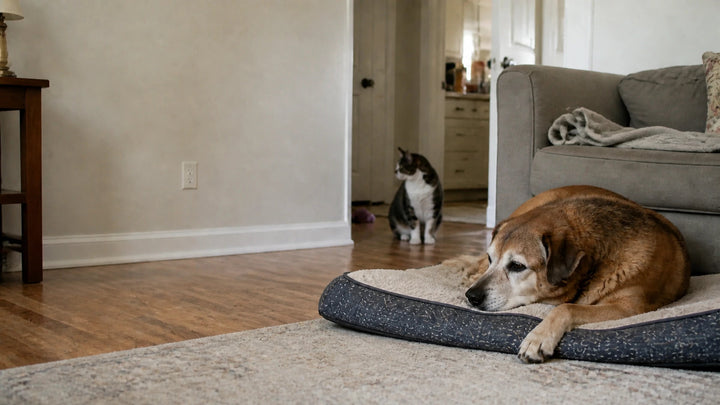
He has come on every trip for eleven years. This year you are not sure whether taking him is kind or selfish.
That question deserves a real answer rather than reassurance. Here is a worksheet that gives you one, and the two numbers that decide most of it.
Quick answer
Two numbers decide most trips. Break every 2 hours for a senior dog rather than the 3–4 an adult tolerates. And never leave him in the vehicle — a parked car gains roughly 19 °F in ten minutes and 40 °F in an hour, and cracking the windows barely changes it.
Everything else follows from one rule: never test a new transfer for the first time at a departure point.
The vehicle temperature problem
This is the one section of this guide that is not about comfort.
A parked vehicle gains heat fast and independently of how mild the day feels. Interior temperature rises roughly 19 °F in the first ten minutes and around 40 °F over an hour, with most of that increase happening in the first thirty. Leaving windows partly open does not meaningfully slow it.
Older dogs thermoregulate less efficiently than they once did, and a dog that cannot easily stand or reposition cannot move away from a hot surface or into shade. On a 70 °F day — a day nobody thinks of as hot — the interior passes 89 °F within ten minutes.
Go, modify, or reconsider?
| Decision area | GO | MODIFY | RECONSIDER |
|---|---|---|---|
| Current routine | Stable and predictable | Needs extra breaks | Recent decline or uncontrolled symptoms |
| Vehicle access | Measured and practiced | Equipment needs calm rehearsal | Requires an unsafe lift or untested route |
| Destination | Flooring, stairs, rest area known | One barrier can be changed | Critical access details unknown |
| Care plan | Food, water, medication scheduled | Veterinary clarification needed | Plan conflicts with current medical needs |
| Emergency options | Contacts and route identified | Research one gap | No workable backup |
Reading it: one RECONSIDER outranks four GOs. The worksheet is not scored on balance — a single unworkable element makes the trip unworkable.
The break interval
Guides say “stop regularly.” Here is the interval we use, published so you can adjust it.
| Dog | Break interval | Stop length | Why |
|---|---|---|---|
| Adult, no mobility concerns | every 3–4 hours | 10–15 min | Standard comfort and toileting |
| Senior, moving well | every 2 hours | 15 min | Stiffness builds during immobility; short walking resets it |
| Senior, stiff or unsteady | every 90 min | 15–20 min | Transfers themselves are effortful and need recovery |
Count the transfers, not just the miles. A four-hour drive with three stops means eight vehicle transfers, and for a stiff dog that is the real physical cost of the day — not the sitting.
Measure every transfer
- Vehicle threshold height
- Door or hatch clearance
- Usable landing area inside the vehicle
- Ramp floor run or stair footprint
- Destination steps, elevator, and room route
A 30 in SUV cargo lip needs 92 in of run for a gentle ramp — more than most parking spaces allow. Check the geometry in the Dog Ramp Length & Angle Calculator before assuming a ramp is the answer, and compare against stairs in Dog Stairs vs. Ramps.
Equipment that has to be practiced first
Prices in USD, shipped within the United States. Order early enough to rehearse, not the week of the trip.
Vehicle access
5-Step Folding Stairs for Cars & SUVs
Five steps keeps each rise near 6 in for a 30 in cargo lip, in a footprint a parking space can actually give. Test the base on a driveway surface, not a garage floor.
See current price and available options on the product page.
View detailsRest at the destination
Waterproof Plush Mat, Washable Cover
A flat mat rolls, travels, and needs no entry height in an unfamiliar room. Waterproof backing matters more away from home than it does in your own house.
See current price and available options on the product page.
View detailsFeeding away from home
Ceramic Bowls with Wood Stand, Set of 2
Keep the familiar station rather than improvising with hotel dishes. Routine is the variable most worth protecting on a trip, and feeding is where it breaks first.
See current price and available options on the product page.
View detailsCarriers and portable comfort in Travel & Outdoor Comfort; access equipment in Safer Movement.
Pack by function
Before departure, run the home safety checklist against the temporary destination, then use the daily comfort observation loop to notice changes during and after the trip.
Identity and records
- Current ID and microchip details
- Relevant records and medication list
- Veterinary and emergency contacts
Routine
- Usual food and measured portions
- Water and familiar bowls
- Medication in original containers
Comfort
- Familiar bedding
- Washable towels and cleanup supplies
- Practiced restraint and access equipment
Contingency
- Extra care supplies
- Weather and temperature plan
- Alternative stop or return plan
What to record at each break
| At each planned check | Record |
|---|---|
| Movement | Willingness to rise, gait, slips, transfer comfort |
| Breathing and temperature | Any change from the dog’s normal state |
| Food and water | Intake and any difficulty |
| Behavior | Resting, agitation, confusion, or refusal to continue |
Air, interstate, and international travel
Carrier, health-certificate, airline, state, and destination rules can change. Verify every requirement directly with the carrier and relevant authority close to departure. Do not reuse a past trip’s paperwork as proof of current compliance.
Five things owners get wrong
“Cracking the windows makes the car safe for a few minutes.” — It does not. Partly open windows barely slow the temperature rise, and most of the increase happens in the first half hour.
“He travels well, so nothing has changed.” — What changed is recovery, not tolerance. An older dog may travel just as calmly and take two days to feel normal again.
“Fewer stops means less disruption.” — Backwards for a stiff dog. Stiffness builds during immobility, and short walking resets it. More stops is usually the gentler trip.
“I will test the ramp when we get there.” — The worst possible plan. A first attempt in an unfamiliar, busy place with people waiting is how a dog learns to refuse equipment permanently.
“A senior dog needs a sedative for the journey.” — Never a self-prescribed decision. Sedation affects thermoregulation, balance and swallowing. That is a veterinary conversation, before the trip.
Frequently asked questions
How often should I stop when driving with a senior dog?
Every 2 hours for a senior moving well, and every 90 minutes for one that is stiff or unsteady — against the 3–4 hours an adult dog tolerates. Stop for 15 minutes and let him walk; stiffness builds during immobility and short walking resets it.
Can I leave him in the car for a few minutes?
No. A parked vehicle gains roughly 19 °F in ten minutes and about 40 °F in an hour, and cracking the windows barely changes it. On a 70 °F day the interior passes 89 °F within ten minutes. An older dog that cannot reposition cannot move away from it.
Is my dog too old to travel?
Age alone does not decide it. The worksheet above does: routine stability, tested vehicle access, known destination, a workable care plan, and identified emergency options. One RECONSIDER outranks four GOs.
Should I use a ramp or stairs for the car?
Usually stairs, because of space. A 30 in cargo lip needs 92 in of run for a gentle ramp, which most parking spaces cannot give. Run your own figures in the ramp calculator before deciding.
When should I buy the equipment?
Early enough to rehearse at home, in a quiet parked vehicle, with time to spare. A first attempt at a busy departure point with people waiting is how a dog learns to refuse the equipment permanently.
Should I change his food for the trip?
No. Bring the usual food in measured portions and the familiar bowls. A trip already changes room, routine and sleep — diet is the one variable you can hold constant, and it is worth holding.
What about medication timing across time zones?
Ask your veterinarian before you leave rather than improvising en route. Some medications tolerate a shifted schedule and some do not, and that is not a judgement to make in a hotel room.
Can I give him something to keep him calm?
Not without veterinary direction. Sedation affects thermoregulation, balance and swallowing — all of which matter more in an older dog and more in a vehicle. Have that conversation before the trip, not the night before.
What should I check about the destination?
Flooring type, stairs between the door and the room, and where he will rest. A hotel with polished floors and two flights of stairs is a harder environment than your house, and it is worth knowing before you arrive.
He seems fine during the trip but exhausted after. Is that normal?
Recovery time lengthens with age even when tolerance looks unchanged. Build a quiet day into the return, and mention it to your veterinarian if the recovery keeps getting longer.
Is flying an option for an older dog?
It depends entirely on the individual dog, the airline and the route, and rules change often. Verify requirements directly with the carrier close to departure, and treat fitness to fly as a veterinary question rather than a policy question.
What if I decide not to take him?
That is a legitimate outcome of the worksheet, not a failure. A familiar environment with a familiar carer is often the gentler option, and choosing it deliberately is better than discovering mid-trip that it was the right call.
Glossary
Transfer — One movement into or out of the vehicle. Count transfers, not miles.
Threshold height — Floor to the vehicle entry surface. The figure a ramp or stair must reach.
Landing area — Usable flat space inside the vehicle where the dog arrives and turns.
Break interval — Planned time between stops. Shorter for seniors than for adults.
Rehearsal — Practising a transfer at home before it is needed under time pressure.
Recovery time — How long the dog takes to return to normal after the trip. Lengthens with age.
Go/no-go — A decision framework where one blocking element overrides several passing ones.
Resource duplication — Bringing the familiar bowl and bedding rather than improvising at the destination.
Match gear to the written plan: compare carriers, hydration and portable comfort options in Travel & Outdoor Comfort. If vehicle or destination access is the unresolved constraint, continue with Safer Movement.
Sources and methodology
Zavyro turns observable home measurements into comparison and planning tools. The break intervals published above are a Zavyro planning heuristic, not a veterinary standard. Vehicle temperature figures are those published in AVMA public guidance on pets in vehicles. These guides do not diagnose a condition or replace individual veterinary advice.
Last reviewed: August 14, 2026.