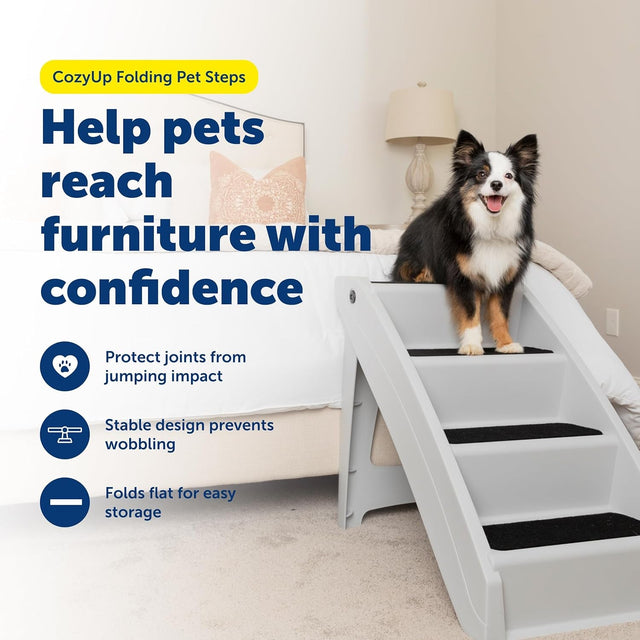
You have decided your dog needs help getting up. Now you are stuck on the actual question: stairs or a ramp?
Most guides answer with adjectives. The honest answer is a number — how much floor space your room can give — and it decides the choice more often than anything about the dog.
Quick answer
Floor space usually decides it. For a 24 in bed, a typical 4-step unit occupies about 32–36 in of floor. A ramp at a gentle 18° needs 74 in — more than twice as much.
Stairs win on footprint. A ramp replaces repeated step transitions with one continuous surface. Measure the room before comparing products, not after.
The number that decides it
Almost every guide says “stairs save space” without saying how much. Here it is, for one 24 in bed:
| Destination rise | Typical stair footprint | Ramp at 18° | Ramp at 25° | Ramp at 30° |
|---|---|---|---|---|
| 16 in (low sofa) | ~20–24 in (2–3 steps) | 49 in | 34 in | 28 in |
| 20 in (standard sofa) | ~24–28 in (3 steps) | 62 in | 43 in | 35 in |
| 24 in (bed) | ~32–36 in (4 steps) | 74 in | 52 in | 42 in |
| 30 in (SUV cargo) | ~36–42 in (4–5 steps) | 92 in | 64 in | 52 in |
Ramp run is calculated as rise ÷ tan(angle). Stair footprints are typical published depths and must be checked against the specific product. The ratio between the two — usually 2× to 2.3× — is why most people who want a ramp end up with one that is too steep.
Options for each answer
Prices in USD, shipped within the United States. Check the stated height or step count against your own measurement before ordering.
You have the floor space
16 in Wooden Dog Ramp & Stairs Ottoman
A continuous ramp surface for a 16 in destination — a sofa or a low bed. Confirm you have the run the calculator asked for before choosing this over steps.
$128.99
View detailsYou do not
4-Step Foldable Dog Stairs Ottoman
Bed height in roughly a third of the floor space a gentle ramp would need. The right answer for most bedrooms, and the one most people skip past.
$108.99
View detailsSmall dogs, low sofa
Low individual rise and a soft surface. Check tread depth against your dog’s paw placement — shallow treads are where small dogs hesitate.
$49.99
View detailsAlso available: foldable non-slip stairs at $59.99, and 5-step stairs for cars and SUVs at $90.99. Full range in Safer Movement.
Five facts decide this choice
- How the dog moves on a familiar step today
- The full floor-to-destination height
- The unobstructed floor run and approach area
- Usable width, traction, stability and weight rating
- Whether the route works in both directions
Ramp or stairs? Use this decision matrix
| Your situation | Evaluate first | Why |
|---|---|---|
| Dog uses household steps steadily; room is tight | Stairs | They gain height in a shorter footprint. |
| Dog avoids step transitions | Ramp | A continuous path removes repeated risers. |
| High bed or SUV | Ramp geometry | A short ramp becomes steeper as height increases. |
| Small dog, low sofa | Low-rise steps or shallow ramp | Match the route to stride and usable width. |
| Large or heavy dog | Structure and rating | Flex or foam compression can alter stability. |
| Home and vehicle use | Two separate setups | One product rarely fits both destinations safely. |
Stair geometry: the two dimensions that matter
The height of one step. Lower rises mean more steps for the same total height, and a longer footprint. Check whether the rise is consistent — some units have a taller first or last step.
The horizontal landing surface per step. It must be deep enough for the dog to place a full paw and settle weight before moving. Shallow treads force an angled placement, which is where hesitation starts.
Test the descent, not the climb
This is the most common testing error and it deserves its own section. Going up is a controlled, powered movement. Going down is a braking movement, and it is where refusals and falls actually occur.
- On stairs, descent requires the dog to see and target each tread while decelerating. Shallow treads and poor edge definition make this harder.
- On a ramp, descent is a continuous braking action. Traction matters far more going down than going up, and a surface that grips on the way up can still slide on the way down.
- A dog that climbs willingly and then hesitates at the top is telling you the descent is the problem — not the product choice.
Test both directions before deciding, on the actual floor, with the equipment in its final position.
Observe before you buy
Watch one familiar route without prompting. Does your dog place each paw deliberately, rush the descent, hesitate before the first step, or avoid the whole route? Record a short side-view video if the change is new. The observation describes behaviour; it does not explain the medical cause.
Measure the actual destination
- Measure vertically from the floor to the top of the mattress, cushion, or vehicle entry surface.
- Measure clear horizontal floor space, including room to approach and exit.
- Record the maximum usable width.
- Note the floor material at the base and the surface at the top.
For a ramp, enter the rise and run in the Dog Ramp Length & Angle Calculator. For stairs, compare total height, individual rise, tread depth and width using the dog-stair worksheet.
Compare the hardware, not the adjectives
| Specification | Useful evidence | Warning sign |
|---|---|---|
| Walking surface | Usable width and grip material stated | Only total product width |
| Base | Stable on your actual flooring | Moves during entry or exit |
| Top contact | Flush, secured, no surprise lip | Gap or unstable overlap |
| Structure | Current weight rating and lock instructions | Vague “for all dogs” claim |
| Care | Specific cleaning instructions | Traction cover loosens after washing |
Five things owners get wrong
“Ramps are always gentler than stairs.” — Only when the floor run exists. A ramp squeezed into a short space is steeper than any stair unit and harder to descend.
“Buy by breed.” — False. Two dogs of the same breed can differ by six inches in shoulder height and stride. Buy by measurement.
“The listed length is the walking surface.” — Often false for ramps. Many listings state folded or overall length.
“Non-slip means the whole thing grips.” — False. The walking surface and the floor-contact base are two separate specifications. A ramp can grip underfoot and still slide across tile.
“If it climbs, it works.” — False. Descent is the harder direction and the one that produces refusals. Test both.
Introduce the route without force
Begin flat or at the lowest supported setting. Reward voluntary investigation. Practise short, calm sessions and observe approach, ascent, transfer, descent and exit. Never pull or push a worried dog across the equipment. Recheck placement after every move or cleaning.
Frequently asked questions
Are stairs or ramps better for dogs?
Neither is universally better. Floor space usually decides: for a 24 in bed, stairs occupy about 32–36 in of floor while a gentle 18° ramp needs 74 in. Choose stairs when the room is tight and the dog already uses steps confidently; choose a ramp when the dog avoids step transitions and you have the floor run.
How much floor space does a dog ramp need?
Run equals rise divided by the tangent of the angle. For a 24 in rise: 74 in at 18°, 52 in at 25°, 42 in at 30°. Add approach and exit room beyond that — roughly one body length at each end.
My dog goes up but won’t come down. What does that mean?
The descent is the problem, not the choice of equipment. Descent is a braking movement that requires traction and clear edge definition. Check the surface grip going down, the tread depth if it is stairs, and whether the top contact shifts when weight transfers.
What tread depth do dog stairs need?
Deep enough for the dog to place a full paw and settle weight before moving to the next step. Shallow treads force an angled placement, which is a common source of hesitation. Measure your dog’s paw placement on a familiar step to compare.
Can I use the same product for the bed and the car?
Rarely. A 24 in bed and a 30 in SUV lip differ by several degrees at the same run, and a vehicle needs a secure top contact on a surface that may be smooth or angled. Measure each destination separately.
Do stairs work for a dog that is losing rear-leg strength?
Stairs require repeated lifting and placing of each foot, which is a different demand from a continuous ramp surface. Whether either is appropriate for a dog with changing strength is a clinical question — discuss it with your veterinarian before choosing equipment.
What weight rating do I need?
More than the dog’s static weight, because movement creates dynamic load. Also check visible flex at mid-span: equipment that meets the rating but bends underfoot will be refused by many dogs regardless of the stated number.
How wide should the walking surface be?
Wider than the dog’s stance, with margin for drift. Narrow surfaces make dogs place feet near the edge, which increases hesitation. Check usable width, not total product width including rails or frame.
Will a ramp slide on hardwood or tile?
It can. “Non-slip” often refers only to the walking surface, not the floor-contact base. These are two separate specifications. Test the assembled product on your actual flooring before the dog uses it.
How long does introduction usually take?
It varies widely. Start flat, keep sessions short and voluntary, and let the dog investigate without pressure. A dog forced across equipment once often refuses it thereafter, which is slower than starting patiently.
Should I remove the equipment when not in use?
Consistent placement helps the dog learn the route. If the equipment must be moved, recheck the top contact and base stability every time it is repositioned — most instability appears after a move or a cleaning.
My dog suddenly stopped jumping on the sofa. Do I need a ramp?
A sudden change in a movement the dog previously did easily is a reason to call your veterinarian, not a reason to buy equipment. Equipment may be part of the answer afterwards; it is not a diagnosis.
Glossary
Rise — Total vertical height from the floor to the destination surface.
Run — Horizontal floor distance the ramp covers, measured out from the destination.
Individual rise — The height of one step on a stair unit, as opposed to total rise.
Tread depth — The horizontal landing surface of one step, front to back.
Footprint — The floor area the equipment occupies in use, including any extended base.
Top contact — Where the equipment meets the destination. Gaps and unstable lips cause most refusals.
Mid-span flex — Bending at the centre under load. Not covered by weight rating alone.
Approach room — Clear floor beyond the base allowing a straight entry and exit.
Sources and methodology
Zavyro turns observable home measurements into comparison and planning tools. Ramp run figures above are calculated as rise ÷ tan(angle). Stair footprint figures are typical published depths for common step counts and must be verified against the specific product. These guides do not diagnose a condition or replace individual veterinary advice.
Last reviewed: August 14, 2026.