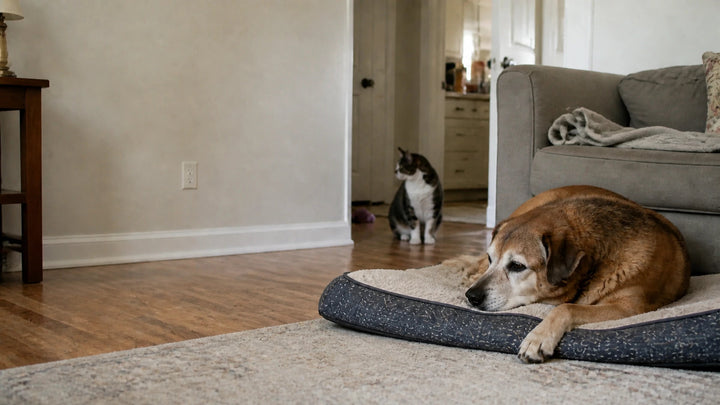
The scrabbling sound on the kitchen floor. The pause at the top of the stairs. The night he slept in the hallway instead of coming to bed.
None of those are the dog getting old. Each one is a specific point on a specific route, and each one is fixable once you know where to look.
Quick answer
Audit routes, not rooms. There are four that matter: bed to water, bed to food, bed to door, bed to where the family sits. Walk each one at your dog’s pace, in both directions.
Traction is the hazard that appears most often and gets fixed least. Score every route below, then fix in the order the scores give you — not the order that is easiest.
The four routes
What “slippery” actually means
Every guide tells you to fix slippery floors. None of them defines slippery, so here is a reference point.
US slip-resistance practice for human walking surfaces uses ANSI A326.3, which sets a dynamic coefficient of friction threshold of 0.42 for level interior floors expected to be walked on when wet. Polished hardwood, sealed tile and laminate commonly fall below that when dry, and well below it when wet.
That is a human standard measured with a test foot, not a paw. Dogs have pads and claws, not shoes, and no canine equivalent exists. It is offered here for one reason: to establish that “slippery” is a measurable property of the floor, not a vague quality of the dog. If a surface would fail for a person in socks, it is failing your dog too.
Before opening the checklist
- Walk each daily route at the dog’s pace.
- Observe it in both directions — descent and approach fail before ascent does.
- Photograph or measure every threshold and furniture transition.
- Write down frequency, not just one memorable event.
- Change one route variable at a time, then recheck.
The scored checklist
Score each line 0, 1 or 2. Any zero outranks every other finding in the house, regardless of total.
| Check | 2 — passes | 1 — watch | 0 — fix now |
|---|---|---|---|
| Route traction | Continuous grip the whole way | Grip with short bare gaps | Dog slips or splays repeatedly |
| Bed entry | Clears the edge without pausing | Brief hesitation | Cannot enter, or sleeps beside it |
| Stairs in the home | Steady both directions | Slow but controlled descent | Rushes, stumbles, or is avoided |
| Thresholds | Stepped over without contact | Occasional toe contact | Trips or stops at the threshold |
| Turning space | Turns without touching furniture | Tight but manageable | Must reverse out |
| Night lighting | Route visible without a light on | Partly lit | Dark route to water |
| Water access | Reachable without stairs | Long route | Requires stairs or a jump |
| Feeding station | Stable, room to stand square | Slight movement | Slides or is cornered |
| Outdoor steps | Grip when wet, lit at night | Dry-weather only | Slick or unlit |
| Hazard access | Pool and open stairs blocked | Blocked when supervised | Unrestricted |
Reading the score: 18–20 means monitor and recheck in three months. 12–17 means one adaptation this week. Below 12 means the routes need work before any product will help. Any single zero is a today item.
Room-by-room field notes
Living and family areas
- Clear cords, loose objects, and narrow turns.
- Secure runners without curled edges — a curled edge is a new hazard, not a fix.
- Keep the route to people and resting places predictable.
Sleep routes
- Measure the bed’s usable surface and lowest entry point.
- Check the approach for sliding.
- Make water reachable without a long night route.
After measuring the sleeping route and entry height, compare only the options in Better Rest that preserve the clear path you documented. The entry-height rule gives you the number to check against.
Food and water
- Stabilize bowls and clean spills before the route is reused.
- Avoid crowding stations into corners where turning is difficult.
- Note appetite, posture, and drinking changes separately from equipment.
Use the station-height, floor-grip and clearance notes from this room before exploring Easier Mealtimes.
Doors and outdoors
- Measure thresholds and steps.
- Check wet-weather traction, lighting, and leash handling space.
- Block unsupervised access to unsafe stairs or pools.
Prioritize what you found
| Priority | Definition | Example | Action |
|---|---|---|---|
| Today | Likely fall, trapping, or blocked access | Repeated slipping near stairs | Block the hazard and create a stable route |
| This week | Route works inconsistently | Jump required to enter bed | Measure and trial one adaptation |
| Monitor | No current failure | Occasional hesitation | Record frequency and recheck date |
Products that address a scored zero
Prices in USD, shipped within the United States. Buy against a finding, never against a category.
If bed entry scored 0
Waterproof Plush Mat, Washable Cover
No bolster means no edge to clear. A dog sleeping beside his bed rather than in it is usually failing the entry, not rejecting the bed.
See current price and available options on the product page.
View detailsIf sofa or bed access scored 0
4-Step Foldable Dog Stairs Ottoman
Check the per-step rise against 0.25 × your dog’s shoulder height first, and confirm the unit does not narrow a turn you already flagged.
See current price and available options on the product page.
View detailsIf the feeding station scored 0
Elevated Ceramic Bowls, Non-Slip Stand
A station that travels across the floor makes the dog chase it into worse footing. Stability first — height is a separate decision entirely.
See current price and available options on the product page.
View detailsAccess equipment in Safer Movement; the coordinated set in Senior Pets.
Use products only after the route is defined
Choose a ramp or stairs only after measuring the destination and floor space. Choose a bed only after measuring sleep posture and entry height. A collection is a comparison starting point — not evidence that every item fits the dog or the room.
Recheck after every adaptation
Watch the entire route in both directions. A new mat can create a curled trip edge. A ramp can narrow a turn. A relocated bed can increase the distance to water. Record the date and whether the original problem occurred again.
Five things owners get wrong
“Scattered mats fix a slippery floor.” — They can make it worse. A dog aiming for stepping stones slips in the gaps and at the edges. One continuous runner beats six mats.
“He is just slowing down.” — Slowing down is general. Hesitating at one specific threshold, in one direction, is a route problem with a location and a fix.
“Start with the room he uses most.” — Start with the route that scored zero. Frequency matters less than failure.
“If he can climb it, it is fine.” — Descent fails first, on stairs and on ramps alike. Always audit both directions.
“Buy the senior bundle and be done.” — Equipment bought against a category rather than a finding usually creates a new obstacle in an already tight route.
Frequently asked questions
Where do I start with a senior-proofing audit?
With routes, not rooms. Walk the four paths from the bed — to water, food, the door, and where the family sits — at your dog’s pace, in both directions. Score each line of the checklist above and fix any zero first.
How do I know if my floor is too slippery?
US slip-resistance practice sets a dynamic friction threshold of 0.42 for level interior floors walked on when wet. Polished hardwood, sealed tile and laminate commonly fall below it. No canine standard exists, but if a floor would fail for a person in socks, it is failing your dog.
Are runners better than individual mats?
Almost always. A dog crossing scattered mats has to target each one and slips in the gaps between them. Continuity along the worst route matters more than total coverage.
My dog splays his legs on the kitchen floor. What does that mean?
Splaying is a traction failure, and it is one of the earliest visible signs. It usually appears on hard floors before it appears anywhere else. Fix the surface, and mention the change to your veterinarian if it is new.
Should I block the stairs completely?
Block unsupervised access when descent is unsteady. A gate is a low-cost intervention against a high-cost outcome, and it buys time to work out whether the stairs can be made usable again.
Does night lighting really matter?
Yes. Vision changes with age, and the route to water is often walked in the dark. Low-level lighting along that one path is among the cheapest adaptations in this guide.
How often should I redo the audit?
Every three months once a dog is in its senior years, and after any change — new furniture, a new rug, a move, or a new adaptation. Adaptations create new routes, and new routes create new failures.
He hesitates in one doorway but nowhere else. Why?
Look for a threshold strip, a change of flooring, a lighting shift, or a narrow turn immediately after. A single-location hesitation is nearly always a property of that location, not of the dog.
Should the water bowl move upstairs?
If the night route to water crosses stairs, add a second bowl rather than moving the first. Duplicating a resource is safer than lengthening a route, and it costs almost nothing.
What about outdoor steps in winter?
Wet and icy steps fail well before dry ones. Audit the outdoor route in the conditions it actually gets used in, not on a dry afternoon, and check lighting for the late walk.
Can I fix everything at once?
Better not to. Change one route variable at a time and recheck, or you will not know which change helped — and you may not notice that one of them created a new problem.
My dog fell. Is that a home-safety problem?
Treat it as both. Fix the location, and call your veterinarian. A fall can be caused by the floor, but it can also be the first visible sign of something the floor did not cause.
Glossary
Route — A complete path the dog uses daily, audited end to end and in both directions.
Dynamic coefficient of friction — The measured slip resistance of a floor in motion. ANSI A326.3 sets 0.42 for level interior floors walked on when wet.
Splaying — Legs sliding outward on a hard floor. An early and visible traction failure.
Threshold — Any raised strip or flooring change the dog must step over.
Turning space — Clear floor allowing the dog to change direction without reversing out.
Continuity — Uninterrupted grip along a route. More protective than total coverage area.
Resource duplication — Adding a second water bowl or bed rather than moving the first.
Recheck — Re-auditing a route after an adaptation, because every change creates a new route.
Address the route before the product: if your audit identified access or traction gaps, compare solutions in Safer Movement. For coordinated rest, feeding and mobility adaptations, browse the wider Senior Pets collection.
Sources and methodology
Zavyro turns observable home measurements into comparison and planning tools. The scoring bands published above are a Zavyro audit heuristic, not a veterinary or industry standard. The slip-resistance figure cited is a human walking-surface standard with no canine equivalent, offered as a reference point rather than a canine threshold. These guides do not diagnose a condition or replace individual veterinary advice.
Last reviewed: August 14, 2026.