Short answer: Pick the hard plastic shell for a wipe-clean house that keeps its shape, with an escape door and a lift-off roof. Pick fabric for a larger size, a window, a foldable shelter or the most insulation layers. Either way, raise it, keep the plug dry and place it out of the wind.
Key takeaways
- The shell decides upkeep, not warmth alone. Plastic wipes clean; fabric houses rely on layers and covers.
- Our only hard-shell model is the Insulated Plastic Heated Cat House, with double-wall HDPE walls.
- Fabric gives you more choice: a window, the largest size, six insulation layers or a foldable frame.
- Placement matters more than material. Alley Cat Allies recommends raising any shelter off the cold ground and keeping the door small.
- Every heated model needs the same power setup: a covered, outdoor-rated GFCI outlet and a dry plug, as each listing states.
Shop this guide
- Insulated Plastic Heated Cat House with Escape Door: rigid double-wall HDPE shell, removable roof, raised floor, removable thermostatic pad. Standard or Wide.
- Waterproof 6-Layer Heated Cat House: 900D Oxford fabric over six layers, entrance awning, Medium or XL.
- Heated Cat House with Escape Door & Window: fabric, three-layer insulation, side escape door, window, base raised about 5.9 in.
- Foldable Insulated Cat Shelter with Heating Pad: Oxford fabric, EVA and foil lining, folds flat off-season.
Zavyro tool
Plastic or fabric? Shell chooser
Read down the left column and stop at the first row that describes your situation. The match is based only on features stated in each product listing.
| Your situation | Shell to favor | Model that lists it |
|---|---|---|
| You want to wipe the inside and outside clean, and lift the roof off to reach in | Plastic | Insulated Plastic Heated Cat House |
| Raccoons or dogs visit and you want an escape door plus a rigid shell | Plastic | Insulated Plastic Heated Cat House |
| You need to store the shelter flat when winter ends | Fabric, foldable | Foldable Insulated Cat Shelter |
| You want the most insulation layers listed in our range | Fabric | Waterproof 6-Layer Heated Cat House |
| A wary cat needs to see out, and you also want an escape door | Fabric | Heated Cat House with Escape Door & Window |
| You need the largest listed size | Fabric over a frame | Large Heated Cat House with Skylight |
| Space is tight: a small porch or corner | Fabric, compact | Small Heated Outdoor Cat House, Camo |
Why the shell matters
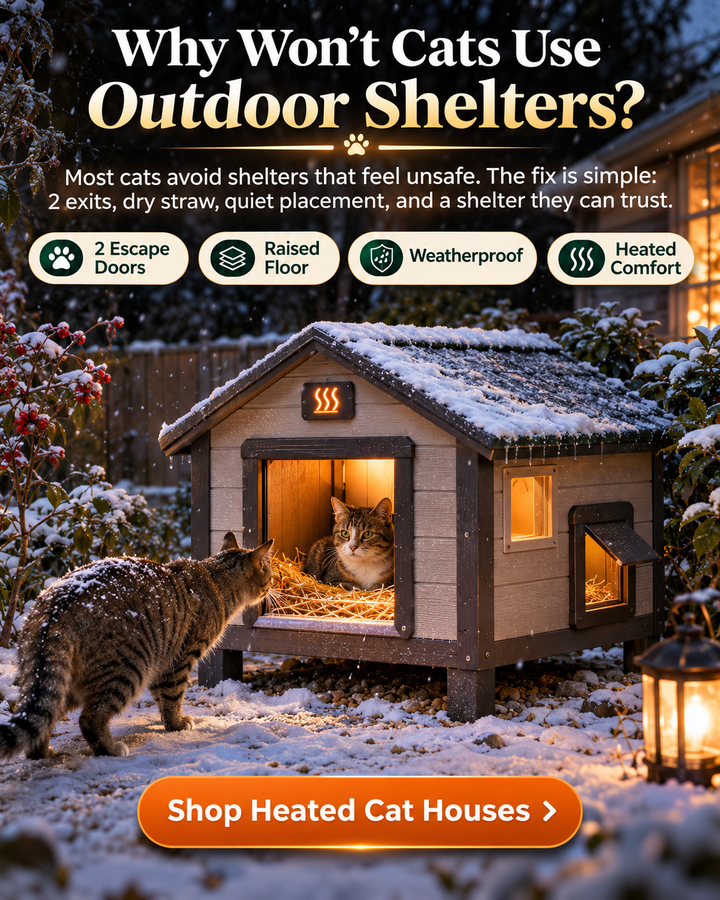
Every heated outdoor cat house does the same basic job: a heating pad adds warmth, and the walls hold that warmth in and keep wind, rain and snow out. Two houses with similar pads can feel very different to live with because of what the walls are made of. The shell decides how you clean it, whether it holds its shape, how it stores in summer and what choice of sizes and features you get.
In our range, the split is simple. One model has a rigid plastic shell. The other six use fabric: Oxford cloth outside, with insulating layers such as pearl cotton, EVA or aluminum foil inside, depending on the model. Neither is "better" in every yard. This guide sets out what each listing actually says, so you can match the shell to your situation.
A note on what we can and can't tell you: we have not run durability or temperature tests on these houses. Everything below comes from the manufacturers' listings, which we identify as such, and from the published guidance of cat welfare organizations.
The plastic option: double-wall HDPE
Our Insulated Plastic Heated Cat House is the only hard-shell model in our heated range. HDPE stands for high-density polyethylene, a rigid plastic. According to its listing:
- Double-wall HDPE walls help reduce heat loss and block wind.
- A removable roof lifts off so you can reach inside and wipe the surfaces clean.
- A thermostatic heating pad in waterproof PVC is included, and it can be removed in warmer seasons so the house works as an unheated shelter.
- Two doors: a transparent main door plus an escape door. The product images show an exit-only door with a magnetic lock.
- A floor raised about 3 inches on four plastic feet, with smooth, rounded interior edges.
- Two sizes: Standard, 17.7 × 14.9 × 17.5 in, and Wide, 17.7 × 17.7 × 17.5 in.
Where plastic makes life easier. A rigid shell keeps its shape without a frame, and a wipe-clean surface suits caretakers who check a shelter often and want to clean it quickly between cats. The lift-off roof also makes it simple to replace bedding or check the pad without tipping the house over.
What to keep in mind. The plastic house is a fixed size: it doesn't fold for storage. Its listing does not mention ground stakes, so in a windy, open spot, set it against a wall or fence, or on a level, stable base. Like every heated model, it needs a covered, outdoor-rated GFCI outlet and a dry plug.
The fabric options: layers, sizes and folding
Our fabric houses use an Oxford cloth exterior over insulating layers. The details differ a lot from model to model, so it helps to read them side by side.
Most layers: Waterproof 6-Layer Heated Cat House
The Waterproof 6-Layer Heated Cat House lists six layers: 900D Oxford fabric, a UV-resistant coating, a cold-resistant layer, PVC, insulating foil and cotton. It adds an entrance awning to help reduce drafts, a raised base, and a plush heated pad. It comes in Medium and XL. Its listing notes that exact dimensions for each size are still being confirmed with the supplier, so contact us before ordering if you need precise measurements.
Window and escape door: Heated Cat House with Escape Door & Window
The escape-door and window model lists three-layer insulation (waterproof Oxford cloth, pearl cotton and an aluminum-foil lining), a covered entrance with a PVC door curtain, a side escape door and a window. Its base is raised about 5.9 inches, the highest listed in our range. The manufacturer rates the pad's maximum temperature at 115°F, and the product images show a metal chew-resistant cord cover. Medium is 20.5 × 12.6 × 17.7 in; Large is 24.8 × 14.9 × 17.3 in, both including the base.
Largest size: Large Heated Cat House with Skylight
The skylight model is about 25.2 × 15.75 × 21.65 inches, the largest listed size in our heated range. It uses 900D Oxford fabric over an internal frame that holds its shape, five insulating layers with waterproof layers, a sloped roof with extended eaves and a thermostatic pad. Its listing does not describe an escape door.
Foldable: Foldable Insulated Cat Shelter
The foldable shelter uses Oxford fabric, reinforced EVA and an aluminum-foil lining, with a raised, moisture-resistant base and ground stakes. It includes a thermostatic heating pad (about 19.3 × 13 in, with a 6 ft cord, per the supplier's size image). It sets up without tools and folds away when the weather warms, which also makes it a practical second shelter.
Most compact: Small Heated Outdoor Cat House, Camo
The small camo house measures 13 × 17 × 18 inches. It lists five-layer insulation, a waterproof exterior, a covered entrance, a raised base, a quick-open roof for cleaning, an exit-only rear escape door and UL-tested heating components.
Side by side: what each listing states
| Model | Shell | Insulation listed | Escape door | Raised | Cleaning access | Folds |
|---|---|---|---|---|---|---|
| Insulated Plastic | Rigid HDPE | Double wall | Yes | About 3 in | Lift-off roof, wipe-clean | No |
| Waterproof 6-Layer | 900D Oxford | Six layers | Not listed | Yes | Not described | Not listed |
| Escape Door & Window | Oxford cloth | Three layers | Yes, side | About 5.9 in | Removable pad and fleece mat | Not listed |
| Skylight, Large | 900D Oxford on a frame | Five layers | Not listed | Yes | Not described | Not listed |
| Foldable Shelter | Oxford, EVA, foil | Lined | Not listed | Yes | Removable cushion | Yes |
| Small Camo | Waterproof exterior | Five layers | Yes, exit-only rear | Yes | Quick-open roof | Not listed |
"Not listed" or "not described" means the listing does not mention that feature. It does not mean the feature is absent, only that we can't confirm it.
We left out the Indoor & Outdoor Elevated Heated Cat House from this comparison because its listing positions it for indoor use, garages and covered outdoor spots rather than open yards.
Five questions that matter more than the shell
Whichever material you choose, the published guidance on outdoor cat shelters points to the same priorities. Get these right first.
- Is it off the ground? Alley Cat Allies recommends raising a shelter off the cold ground to protect it from dampness. All six models above list a raised base or floor.
- Is the door small and out of the wind? Alley Cat Allies says the doorway should be only big enough for cats; Cats Protection advises facing it away from the wind.
- Is there a second way out where other animals visit? Cats Protection advises two entry points where possible. Our guide to escape doors versus single doors helps you decide.
- Is the plug safe? Each listing calls for a properly protected, outdoor-rated GFCI outlet, with the plug and connections kept sheltered and dry.
- Is the size right for the cats? Alley Cat Allies describes about two by three feet, at least 18 inches high, for three to five cats. Fewer cats need less space, and a smaller space is easier for their body heat to warm.
Worked examples
One stray, back porch, raccoons at night, caretaker checks daily
Escape door needed, and frequent cleaning is likely. The plastic house fits: rigid shell, escape door, lift-off roof. Place it against the porch wall with the main door turned away from the wind.
Two cats, open yard, heavy snow, storage space is short in summer
A foldable fabric shelter stores flat in spring. Stake it down, raise it, and clear the doorway after each snowfall. If wildlife visits, add a second shelter with an escape door nearby.
Common mistakes
- Choosing on material alone. A plastic house in the wind, or a fabric house on wet ground, will disappoint. Placement comes first.
- Buying the largest size "to be safe". More space is harder for cats to warm.
- Covering the pad's controls with bedding. If you add straw, follow the manufacturer's instructions and keep it clear of the controls and cord.
- Running an indoor extension cord outside. The CPSC advises using an extension cord outdoors only if it is marked for outdoor use.
- Cutting a second door into a heated house. Choose a model that already has one.
FAQ
Is a plastic or fabric cat house warmer?
We can't say from testing, because we haven't measured inside temperatures. Warmth depends on the walls, the size, the door, the placement and the pad. The plastic house lists double-wall walls; the fabric houses list three to six insulating layers.
Which heated cat house is easiest to clean?
The plastic house lists a lift-off roof and wipe-clean surfaces. Among the fabric houses, the small camo house lists a quick-open roof, and the foldable shelter and window model list removable cushions or pads.
Can I leave the heating pad out in mild weather?
The plastic house's listing says the pad can be removed in warmer seasons, so the house works as an insulated shelter. Check each listing for the other models.
Which models have an escape door?
The plastic house, the escape-door and window model, and the small camo house. The others do not list one.
Can a fabric house stay out in the rain?
Several fabric models list waterproof exteriors, and each listing still recommends a covered spot to keep the electrical connections dry.
Do I need ground stakes?
In an open, windy spot, a stable base helps. The foldable shelter, the skylight model and the small camo house show ground stakes in their listings or images. For the plastic house, use a wall, fence or level base instead.
Do these houses use a lot of electricity?
Our listings don't state the pads' wattage, so we can't give a figure. Read the label on the pad, then use the formula in our guide to what a heated pet bed costs to run.
Sources and methodology
How the shell chooser works. Each row matches a common caretaker need to the model whose listing states the relevant feature. It does not rank warmth or durability, which we have not tested.
- Zavyro product listings: shell materials, insulation layers, doors, raised bases, dimensions, pads and power requirements as published by each manufacturer.
- Alley Cat Allies, cold weather tips for cats: shelter size, raised base, doorway only big enough for cats.
- Cats Protection (UK), how to make a stray cat shelter: two entry points, door away from the wind.
- U.S. Consumer Product Safety Commission, extension cord safety: use cords outdoors only if marked for outdoor use.
Limitations. We have not run durability, weatherproofing or temperature tests. Manufacturer descriptions are identified as such.
Related guides
- How to Keep Outdoor Cats Warm in Winter: Shelter Planner
- Escape Door, Flap or Single Door? How to Choose a Cat Shelter Entrance
- Why Won't Feral Cats Use the Shelter? 9 Reasons and the Fix for Each
- Heated Cat House in a Power Outage: A Backup Plan for Outdoor Cats
- Are Heated Outdoor Cat Houses Safe? How the Pad Works and a Setup Checklist
- How Much Does a Heated Pet Bed Cost to Run?