For the K&H heated beds and pads covered in this guide, yes: K&H says they are designed for continuous operation when used as instructed. That is a product-specific statement, not permission to leave every heated pet bed from every brand running indefinitely.
Quick answer
K&H says its relevant heated beds and pads can remain plugged in all day, while recommending that they be unplugged for an extended vacation. The same product family is thermostatically controlled and not pressure sensitive: it emits heat whenever plugged in, and a resting pet feels a warmer surface because its body insulates the heated area.
The practical conditions are straightforward: use the exact model as its instructions specify, plug it into the outlet configuration the manufacturer allows, keep the cord undamaged, use the product only in its rated environment, and make sure the pet can voluntarily move away from the heated area.
Key takeaways
- 24/7 is manufacturer guidance for specific K&H products, not a universal rule.
- Low wattage alone does not prove unattended-use safety. The answer rests on the manufacturer's intended use, thermostatic control, safety certification and correct setup.
- K&H heated beds are not activated by weight.
- For the MET-listed models covered here, follow K&H's no-extension-cord instruction.
- Unplug for an extended vacation and any time the cord or product is damaged.
- The pet must be able to leave the heated area.
1. What K&H says
| Question | K&H guidance for the products covered here |
|---|---|
| Can it remain plugged in all day? | Yes, when the product is used as instructed |
| Extended vacation? | Unplug it |
| Activated by the pet's weight? | No; K&H says the heated beds and pads are not pressure sensitive |
| Produces heat while empty? | Yes; the empty surface remains modestly above ambient temperature |
| Extension cord? | Follow the exact model instructions; K&H's MET-listed products covered here say not to use one |
2. How the thermostatic heat behaves
K&H's current Pet Bed Warmer page says the empty surface remains roughly 10–15 °F above ambient room temperature and the area insulated by a resting pet warms toward approximately 102 °F. That does not mean the pet switches the heater on. The warmer is already producing heat; the pet's body reduces heat loss to the room.
If the bed seems cold when empty, use the 20-minute pillow test rather than adding weight or assuming a pressure switch has failed.
3. Why low wattage is not the argument
A 4–22 W pet-bed warmer uses far less power than a space heater, but wattage is an energy-use figure, not a complete unattended-use safety certificate. The stronger evidence is the manufacturer's intended-use statement, thermostatic regulation, whole-product safety testing, correct installation and the condition of the unit in your home.
For cost arithmetic, use Heated Pet Bed Running Cost: Table & Formula. That page intentionally separates energy cost from safety claims.
4. Continuous-use checklist
- Use the correct environment. Indoor products stay indoors; select an indoor/outdoor-rated model where the environment requires it.
- Use the outlet configuration the manual requires. Do not substitute an extension cord where K&H prohibits one.
- Keep a cooler resting option available. The pet should be able to move away from the warmed area.
- Inspect the cord and plug. Stop using the product if you see chew marks, cracking, discoloration, deformation or other damage.
- Clean according to the exact model instructions. Unplug first and remove the warmer when the bed's wash instructions require it.
- Do not treat automation accessories as safety controls. A timer or smart plug does not replace the product's thermostat, manual or electrical instructions.
5. When to unplug
| Situation | Action |
|---|---|
| Normal overnight use at home, correct setup | Can remain plugged in if the exact model is documented for continuous use |
| Normal workday, correct setup | Same manufacturer guidance applies |
| Extended vacation | Unplug |
| Before washing or removing a warmer | Unplug |
| Chewed, cracked, pinched or discolored cord/plug | Stop using the product |
| Abnormal heat, odor or deformation | Unplug and discontinue use pending support/inspection |
| Pet cannot move away from the heat unaided | Use only with veterinary guidance |
6. Products covered in this guide
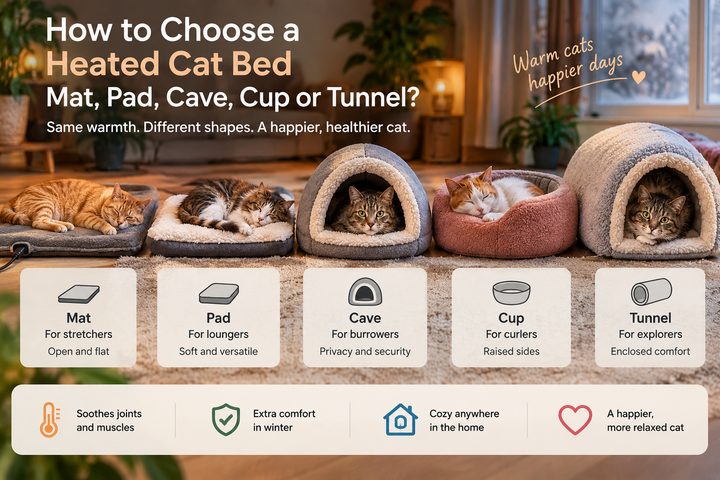
- K&H Thermo-Kitty Heated Cat Bed — indoor heated mat.
- K&H Amazin' Thermo-Kitty Heated Cat Pad — compact indoor pad.
- K&H Pet Bed Warmer, 4–22 W — indoor thermostatically controlled insert.
- K&H Lectro-Soft Indoor/Outdoor Heated Pet Bed — use where an indoor/outdoor rating is needed.
- K&H Microwavable Pet Bed Warmer — cord-free stored-heat option; it is not the same as a continuously powered bed.
7. Young, convalescent or mobility-limited pets
K&H's safeguards specifically advise veterinary consultation for young puppies or kittens, convalescent pets, animals during surgery/recovery, and animals that cannot voluntarily remove themselves from the heated pad. Age alone is not the issue; the important question is whether the animal can recognize discomfort and move away.
8. FAQ
Can I leave a K&H heated cat bed plugged in overnight?
For the K&H models documented for continuous use, yes, when installed and used as instructed and when the pet can move away from the heated area.
Can I leave it on while I am at work?
K&H's continuous-use guidance applies to normal all-day operation for the models it documents that way. Damage, incorrect environment or cord chewing changes the answer.
Can I use an extension cord?
Follow the exact product manual. The MET-listed K&H models covered in the manufacturer's guidance say not to use an extension cord.
Does the cat's weight switch it on?
No. K&H says the beds and pads are not pressure sensitive.
Should I unplug it when I travel?
For an extended vacation, K&H recommends unplugging it.
9. Sources and methodology
- K&H Pet Products — Are Heated Cat Beds Safe to Leave Plugged In?
- K&H Pet Products — Common Questions About Heated Pet Beds
- K&H Pet Products — Pet Bed Warmer (thermostatic behavior, sizes, indoor rating and testing)
Limitations. This article cannot inspect your outlet, wiring or individual unit. The manual for the exact product you own takes precedence over a general guide.