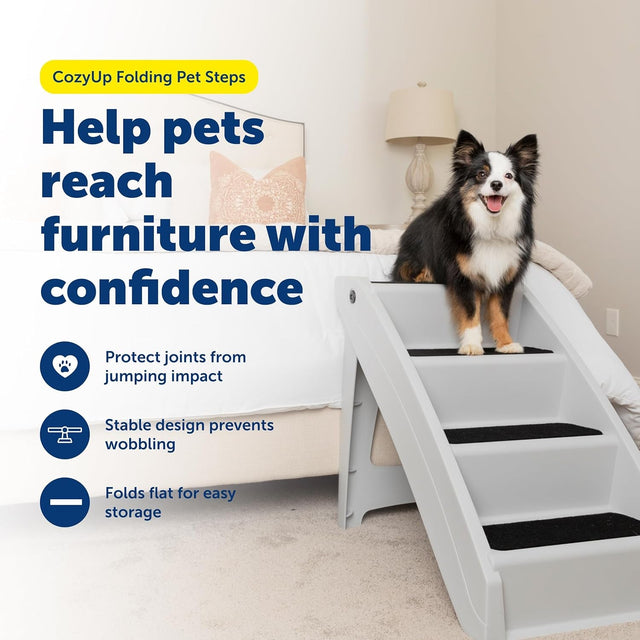
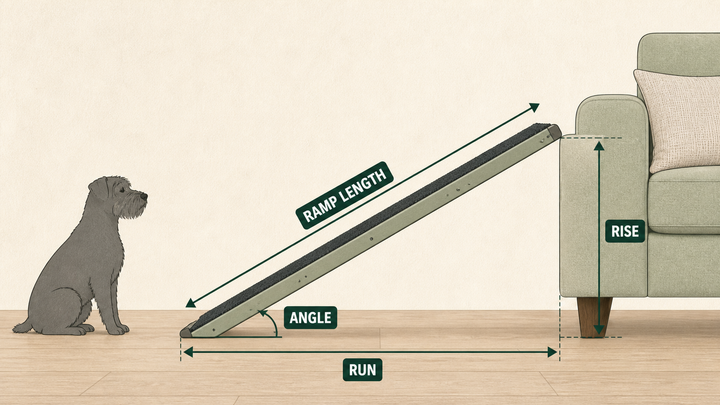
You measured the bed, found stairs the right total height, and your dog still scrambles up them or refuses to come down.
Total height is the least important of the four numbers. Here are the other three, and the rule that explains why most stairs are wrong for small dogs.
Quick answer
Individual step rise should stay at or below 0.25 × your dog’s shoulder height — or 0.20× for a dog that already hesitates. A 24 in dog can handle a 6 in rise; a 10 in dog needs 2.5 in.
That rule has a consequence nobody advertises: a small dog reaching a 24 in bed would need about ten steps. Most units have three or four.
The published fit rules
Most stair guides tell you to “pick an appropriate height.” Here are the actual proportions we use, stated openly so you can check or reject them.
| Dimension | Target | Why |
|---|---|---|
| Individual step rise | ≤ 0.25 × shoulder height ≤ 0.20 × if the dog hesitates |
Above this the dog pushes rather than steps, and descent becomes a controlled drop. |
| Usable tread depth | ≥ 1.5 × front paw length | The paw must land fully with margin, not overhang the edge. |
| Usable width | ≥ 1.3 × body width standing | Room to drift without a foot finding the edge. |
These are Zavyro fit heuristics derived from movement observation, not a veterinary or industry standard.
What the rise rule means in practice
| Shoulder height | Max step rise | Steps for an 18 in sofa | Steps for a 24 in bed |
|---|---|---|---|
| 10 in | 2.5 in | 8 | 10 |
| 16 in | 4.0 in | 5 | 6 |
| 20 in | 5.0 in | 4 | 5 |
| 24 in | 6.0 in | 3 | 4 |
| 28 in | 7.0 in | 3 | 4 |
Your dog-stair worksheet
| Field | Your measurement | Product specification | Difference |
|---|---|---|---|
| Destination height | _____ in | _____ in total height | _____ in final gap |
| Step rise | Shoulder height × 0.25 = _____ | _____ in per step | _____ |
| Tread depth | Paw length × 1.5 = _____ | _____ in usable depth | _____ |
| Usable width | Body width × 1.3 = _____ | _____ in between edges | _____ |
| Floor footprint | Available: _____ × _____ | _____ × _____ | Fits: yes / no |
Options that state their step count
Prices in USD, shipped within the United States. Check the stated per-step rise against your own calculation before ordering.
Bed height, medium to large dog
4-Step Foldable Dog Stairs Ottoman
Four steps suits a dog around 24 in at the shoulder reaching a bed. Below 20 in, four steps means each rise is too tall — check the per-step figure, not just the total.
$108.99
View detailsSmall dogs, low destination
The right shape for a small dog reaching a low sofa — not a bed. Foam compresses under load, so the effective rise is slightly taller than the stated one.
$49.99
View detailsCar or SUV
5-Step Folding Stairs, Cars & SUVs
Five steps for a 30 in cargo lip keeps each rise near 6 in. Confirm the base does not travel on a driveway surface before the first use.
$90.99
View detailsAlso: foldable non-slip stairs at $59.99. Full range in Safer Movement.
Measure in the right order
- Destination: floor to mattress, cushion, or vehicle surface.
- Dog: shoulder height, front paw length, body width standing.
- Room: clear footprint plus approach and exit space.
- Movement: watch a familiar step without forcing a test.
- Product: total height, number of steps, rise, tread, width, and rating.
Score each candidate
| Check | 2 points | 1 point | 0 points |
|---|---|---|---|
| Final transition | Nearly flush and predictable | Small manageable difference | Large gap or lip |
| Step rise | At or under 0.25 × shoulder height | Slightly over | Requires scrambling |
| Tread depth | Full stable paw placement | Borderline | Dog rushes or overhangs |
| Width | Straight travel with clearance | Limited clearance | Body crowds edges |
| Base and structure | Stable on actual floor | Needs approved stabilization | Slides, rocks, or compresses |
Interpretation: a score helps compare candidates; it does not override a failed zero-point safety check.
Read dimensions like an editor, not an ad
“Four steps” reveals less than individual rise. Outside depth reveals less than usable tread. A soft cover may hide a rounded edge. Overall width may include rails or hinges. Ask for the dimensions the paws actually use.
If a staircase still creates a high rise or cramped tread after you score it, revisit the broader stairs versus ramps decision before buying.
Foam, rigid, and foldable stairs
Foam
Light and often quiet, but compression can change rise and stability. Verify the intended weight and the base.
Rigid
Defined treads and platforms, but joints and feet must not rock on the real floor.
Foldable
Convenient storage, but every lock and contact point must engage before use.
Run a three-trip test
Observe approach, climb, transfer, descent, and exit three times: once fresh, once during an ordinary routine, and once after the stairs have been moved and reset. Stop if the dog freezes, scrambles, leaps off the side, or avoids descent.
Five things owners get wrong
“Total height is the spec that matters.” — False. Total height only tells you whether the unit reaches. Individual rise tells you whether the dog can use it.
“Small dogs need small stairs.” — Backwards. Small dogs need more steps for the same destination, because their maximum comfortable rise is smaller. Small units usually have fewer steps, not more.
“Foam is softer so it is safer.” — Incomplete. Foam compresses under weight, which makes the effective rise taller than the stated one and can destabilise the top step.
“The listed width is the walking width.” — Often false. Overall width may include rails, frame or hinges. Ask for the clear space between edges.
“If it climbs, it works.” — False. Descent is the harder direction and where refusals appear. Test both, every time.
Frequently asked questions
How tall should each step be?
At or below 0.25 × your dog’s shoulder height, and 0.20 × for a dog that already hesitates on steps. A 24 in dog can handle roughly 6 in per step; a 16 in dog needs about 4 in.
How many steps do I need?
Divide the destination height by the maximum rise. A 24 in bed at 6 in per step needs four steps; at 4 in per step it needs six. If the answer exceeds what any product offers, stairs are the wrong tool for that destination.
Are stairs suitable for a small dog reaching a bed?
Usually not. A dog under about 14 in at the shoulder would need eight to ten steps to reach a 24 in bed at a comfortable rise, and no commercial unit provides that. A ramp or a lower destination is the honest answer.
What tread depth is enough?
At least 1.5 × your dog’s front paw length, measured as usable depth rather than outside depth. The paw must land fully with margin, not overhang the leading edge.
How wide should the steps be?
At least 1.3 × your dog’s standing body width, measured between the inner edges. Overall product width often includes rails or frame that the dog cannot use.
Does foam change the rise?
Yes, under load. A foam step compresses when the dog puts weight on it, which increases the effective rise to the next step and can make the top transition less predictable. Factor that in when the stated rise is already near your limit.
My dog climbs but will not come down. Why?
Descent requires the dog to see and target each tread while braking. Shallow treads, rounded edges and poor edge definition all make that harder. The problem is nearly always tread depth or edge visibility, not total height.
What about the gap at the top?
The final transition onto the furniture should be nearly flush. A gap or a lip at the top is the single most common cause of a dog refusing an otherwise well-sized unit, because it is the least predictable moment in the route.
Do I need to secure the stairs to the bed?
Follow the manufacturer’s instructions. What matters in practice is that the unit does not shift when weight transfers at the top — test that by hand before the dog uses it, and retest after every move or cleaning.
Can two dogs share one unit?
Size for the one with the tighter constraint — usually the smaller or less confident dog. A rise that suits the larger dog will not suit the smaller one, and the smaller dog is the one who will stop using it.
How do I introduce them?
Short voluntary sessions, no pushing or pulling. Reward investigation before asking for a full climb. A dog forced across equipment once often refuses it thereafter, which costs more time than starting patiently.
My dog used stairs fine last month and now avoids them. What changed?
Something did, and it is unlikely to be the stairs. A newly avoided route the dog previously used easily is a reason to call your veterinarian, not a reason to buy a different unit.
Glossary
Total height — Floor to the top platform of the unit. Tells you whether it reaches, nothing more.
Individual rise — The height of one step. The dimension that decides whether the dog can use the unit.
Usable tread depth — The flat landing surface per step, excluding rounded edges and overhang.
Usable width — Clear space between the inner edges, excluding rails, frame and hinges.
Final transition — The step from the top platform onto the furniture. Should be nearly flush.
Effective rise — The real rise once foam compresses under the dog’s weight. Always ≥ the stated rise.
Approach room — Clear floor in front of the first step allowing a straight entry.
Edge definition — How visible each tread edge is. Poor definition makes descent harder, especially for older eyes.
Take the scorecard with you: compare documented height, rise, tread depth and footprint across Safer Movement products. For a wider set of age-friendly home options, explore the Senior Pets collection.
Sources and methodology
Zavyro turns observable home measurements into comparison and planning tools. The rise, tread and width proportions published above are Zavyro fit heuristics derived from movement observation, not a veterinary or industry standard. They are stated openly so they can be checked, adjusted or rejected. These guides do not diagnose a condition or replace individual veterinary advice.
Last reviewed: August 14, 2026. Method: max step rise = shoulder height × 0.25; steps required = destination height ÷ max step rise, rounded up.