If your aquarium tests positive for ammonia, the priorities are the same in every tank: stop adding to the load, dilute what is already in the water with a partial water change, protect the fish while the biological filter catches up, and keep testing until the reading returns to zero. Ammonia is produced continuously by fish waste, uneaten food and decaying matter. In a fully cycled aquarium, nitrifying bacteria consume it as fast as it appears — so a reading above zero means the filter is not keeping up with the load, and the gap is what you have to close.
This guide covers what a high ammonia reading actually means, what causes it, the order to work through it, and where an ammonia detoxifier does and does not help.
Emergency checklist: what to do in the first hour
- Stop feeding. Uneaten food is a direct ammonia source. Healthy adult fish tolerate several days without food far better than they tolerate ammonia.
- Test and write down the numbers. Ammonia, nitrite, nitrate, pH and temperature. pH and temperature are not optional here — they decide how toxic the ammonia reading actually is.
- Perform a partial water change with dechlorinated water matched to tank temperature. Dilution is the only thing that immediately lowers the amount of ammonia in the tank.
- Check the filter. Is it running? Was the media recently rinsed under the tap, or replaced? Was the power off for a few hours? Any of these can wipe out the bacteria colony.
- Remove decaying material — a dead fish or snail hidden behind the hardscape, rotting plant leaves, food trapped in the substrate.
- Consider a detoxifier to protect fish between water changes while the biological filter recovers.
- Retest after 12–24 hours and repeat until the reading is zero.
What an ammonia reading actually tells you
Aquarium test kits measure total ammonia nitrogen — the sum of two forms that exist together in water:
| Form | Symbol | Toxicity to fish |
|---|---|---|
| Free ammonia | NH3 | The harmful form |
| Ammonium | NH4+ | Far less harmful |
A standard test kit does not separate the two. It reports the total. The split between them is governed by pH and temperature: the higher the pH and the warmer the water, the larger the share of that total sitting in the toxic NH3 form. The practical consequence is that the same 1 ppm total reading is a considerably more urgent situation in a warm, hard, alkaline African cichlid tank than in a cool, soft, acidic blackwater tank.
Do not try to fix an ammonia problem by changing pH. Raising pH while ammonia is present converts comparatively harmless ammonium into toxic free ammonia. If your pH is low and your ammonia reading is high, the low pH is currently working in your favour — deal with the ammonia first and leave pH alone.
What causes high ammonia in an aquarium
Almost every case traces back to one of these:
- The tank is not cycled. A new aquarium has no established bacteria colony. Ammonia climbs until the colony grows in — the classic new tank syndrome.
- Overfeeding. The single most common cause in established tanks. Food that is not eaten decays.
- Too many fish, too fast. A bacteria colony sized for six fish cannot process the waste of sixteen. Adding stock in large jumps outruns it.
- Filter media rinsed in tap water. Chlorinated tap water kills nitrifying bacteria on contact. Rinse media in old tank water instead.
- Filter media replaced rather than topped up. Throwing out all the old media throws out the colony living on it.
- The filter stopped. A power cut, a clogged impeller or an unplugged pump starves the bacteria of oxygen and flow; several hours is enough to cause losses.
- Something died and was not found. A single decaying fish or snail behind the hardscape produces a surprising amount of ammonia.
- Medication or algae treatment. Some treatments suppress the bacteria colony as a side effect, producing an ammonia spike partway through a course.
- Chloramine in the tap water. Many municipal supplies use chloramine rather than chlorine. When a conditioner breaks the chloramine bond, chlorine is neutralised and ammonia is released into the water — which is why a water change can occasionally be followed by an ammonia reading rather than a lower one.
Water changes: the part that actually removes ammonia
A water change is the only step in this list that physically takes ammonia out of the aquarium. Everything else either stops more from being produced, converts it to a less harmful form, or helps the biological filter process it faster.
Practical points that matter more than the exact percentage:
- Always dechlorinate replacement water. Adding untreated tap water to fix an ammonia problem introduces chlorine or chloramine and damages the very bacteria you need.
- Match the temperature. A large change in temperature is its own stressor stacked on top of the ammonia.
- Several moderate changes beat one enormous one when the tank is already unstable.
- Vacuum the substrate while you drain — trapped waste and food is often where the ammonia is coming from.
Biological filtration: the part that actually solves it
The permanent fix for ammonia is a biological filter that can handle the tank's bioload. Nitrifying bacteria convert ammonia to nitrite, then a second group converts nitrite to nitrate, which you export through routine water changes. This is the aquarium nitrogen cycle, and no bottled product replaces it.
Protect the colony: keep the filter running continuously, rinse media in tank water rather than tap water, replace media in stages rather than all at once, and increase stocking gradually so the colony has time to grow with the load.
Where an ammonia detoxifier fits
Ammonia detoxifiers are aquarium water treatments that change the chemical form of ammonia so it is less harmful to fish, buying time while water changes and the biological filter do the actual work. They are a bridge, not a destination.
One widely used option is API AMMO-LOCK, sold for freshwater and saltwater aquariums. API is explicit about what the product does and does not do:
AMMO LOCK does not remove ammonia; it converts it to a non-toxic form.
[the] aquarium will still test positive for ammonia until it is removed by the biological filter.
— API (Mars Fishcare), official product page
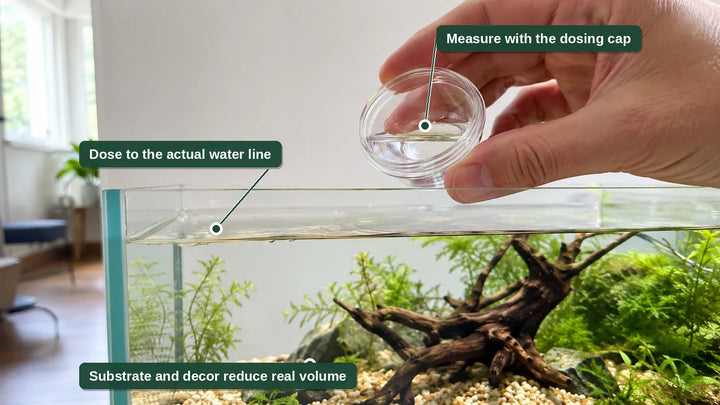
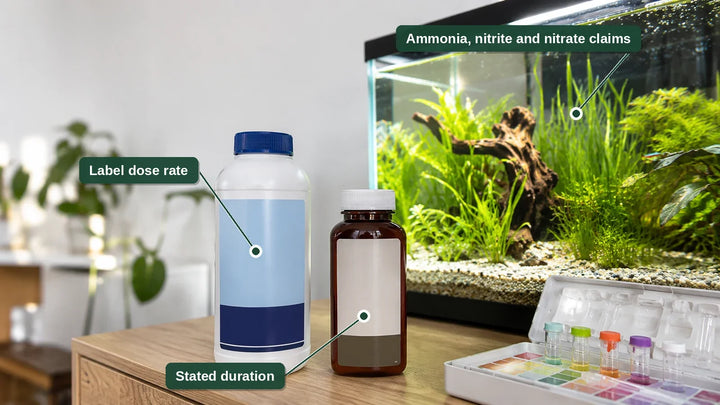
API's label dose is 5 mL per 10 gallons (38 L) of aquarium water, added every 2 days until ammonia is not detected. If ammonia is still present after 7 days, the label directs you to perform a partial water change, service the biological filter and reduce feeding. API frames the product as what to reach for when you cannot do a partial water change straight away — not instead of one. The dosage chart and calculator works that rate out for your own water volume.
What a detoxifier will not do
- It will not remove ammonia from the water. The ammonia is still there in a converted form, and your test kit will still find it.
- It will not cycle your tank for you. Only the bacteria colony does that.
- It will not fix overstocking, overfeeding or a broken filter. Those are the causes; the detoxifier only manages the symptom.
Used with that understanding, a detoxifier is a reasonable part of an emergency response. Used as a substitute for water changes and filtration, it postpones the problem. If you are weighing options, see how AMMO-LOCK compares with the other widely used product in this category in our side-by-side comparison of API AMMO-LOCK and Seachem Prime.
Preventing the next ammonia spike
- Feed only what is eaten in a couple of minutes, and skip a day now and then.
- Add new fish in small groups with time between them.
- Test the tank on a routine, not only when something looks wrong — a reading you catch at 0.25 ppm is a much smaller problem than one you catch at 4 ppm.
- Keep a conditioner on hand so a water change is never delayed for want of one.
- Never rinse filter media under the tap.
- Know whether your water utility uses chlorine or chloramine, and choose a conditioner that covers what is actually in your supply.
Frequently asked questions
What is a safe ammonia level in an aquarium?
The target in a cycled aquarium is zero detectable ammonia. Any persistent reading above zero indicates the biological filter is not keeping pace with the tank's bioload, and how harmful a given reading is depends on the tank's pH and temperature.
How do I lower ammonia in a fish tank fast?
A partial water change with dechlorinated, temperature-matched water is the fastest way to physically reduce the amount of ammonia present. Stopping feeding prevents more from being produced, and an ammonia detoxifier can make what remains less harmful while the biological filter recovers.
Why is my ammonia still high after a water change?
Common reasons: the source of the ammonia is still in the tank (decaying material, a stalled filter, heavy feeding); the change was too small relative to the reading; the tank is mid-cycle and producing ammonia faster than it is removed; or the tap water itself contains chloramine, which releases ammonia when the conditioner breaks the bond.
Does an ammonia remover replace water changes?
No. Products in this category convert ammonia to a less harmful form rather than removing it from the water. API's own directions for AMMO-LOCK still call for a partial water change if ammonia persists beyond 7 days, and API describes the product as what to use until a water change can be done.
Can I add fish while ammonia is present?
Adding stock increases the waste load on a filter that is already behind. Wait until ammonia and nitrite both read zero and stay there.
Is ammonia worse in saltwater or freshwater?
Ammonia is harmful in both. Marine aquariums generally run at a higher pH, which shifts more of a given total ammonia reading into the toxic free-ammonia form — so an identical number on a test kit typically warrants more urgency in a reef or marine tank.
Sources
- API (Mars Fishcare) — official AMMO-LOCK product page and directions for use: apifishcare.com/product/ammo-lock
Browse water treatments, test kits and filtration in Fish & Aquatics. If you have settled on a detoxifier, the API Ammo-Lock dosage chart and calculator gives the amount for your tank, and the product itself is API AMMO-LOCK 1 Gallon.