API AMMO-LOCK and Seachem Prime are both aquarium water treatments that make ammonia less harmful to fish rather than removing it from the water. They overlap on chlorine, chloramine and ammonia, and both are labelled for freshwater and saltwater. The published differences are narrower than the debate around them suggests, and they come down to three things: which nitrogen compounds each manufacturer claims to act on, the label dose rate, and the bottle sizes each is sold in.
Everything below is taken from what API (Mars Fishcare) and Seachem publish themselves. Each row of the comparison names its source. Where we have calculated something rather than quoted it, we say so.
Disclosure. Zavyro sells API AMMO-LOCK. We have deliberately restricted this page to each manufacturer's own published claims and linked the sources so you can verify them. No head-to-head performance testing has been published by either manufacturer, by us, or to our knowledge by an independent laboratory — so this is a comparison of stated specifications, not a verdict on which product performs better in your tank.
API AMMO-LOCK vs Seachem Prime: side by side
| Attribute | API AMMO-LOCK | Seachem Prime | Source |
|---|---|---|---|
| Freshwater | Yes | Yes | Both manufacturers' product pages |
| Saltwater | Yes | Yes — “for both fresh and saltwater” | Both manufacturers' product pages |
| Ammonia claim | Detoxifies. API: “does not remove ammonia; it converts it to a non-toxic form” | Detoxifies. Seachem: “Detoxifies ammonia” | API product page; Seachem product page |
| Chlorine | Yes | Yes — “Removes chlorine” | Both manufacturers' product pages |
| Chloramine | Yes | Yes — “Removes chlorine, chloramine” | Both manufacturers' product pages |
| Nitrite | Not claimed on API's official product page | Yes — “Detoxifies ammonia, nitrite, and nitrate” | API product page (absence); Seachem product page |
| Nitrate | Not claimed on API's official product page | Yes — “Detoxifies ammonia, nitrite, and nitrate” | API product page (absence); Seachem product page |
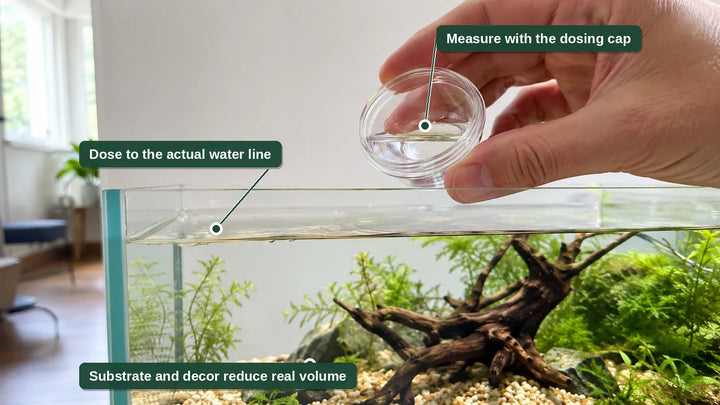
| Label dosage | “Add 5 ml per 10 gallons (38 L) of aquarium water. Add every 2 days until ammonia is not detected.” | “Use 1 capful (5 mL) for each 200 L (50 US gallons) of new water.” | API directions; Seachem directions |
| Re-dosing while ammonia persists | Every 2 days until ammonia is not detected; after 7 days, partial water change, service filter, reduce feeding | “re-dose every 48 hours as necessary until ammonia levels reach 0 ppm” | API directions; Seachem support |
| Stated duration of effect | Not published as a number; dosing interval is every 2 days | “Prime will bind up those compounds for up to 48 hours” | API directions; Seachem support |
| Emergency dosing | No multiplied emergency dose published | “To detoxify nitrite in an emergency, up to 5 times normal dose may be used” | Seachem product page |
| Water change guidance | No percentage published; label directs a partial water change if ammonia persists after 7 days, and API positions the product as a stopgap until a water change can be done | Dosage is specified per volume of new water at each change | API product page; Seachem directions |
| Intended use | Ammonia detoxifier; also treats tap water for chlorine and chloramines | “Complete and concentrated conditioner for both fresh and saltwater” | Both manufacturers' product pages |
| Concentration claim | No comparative concentration claim published | “up to 5x more concentrated than competing products”; “A single 100 mL bottle will treat 1000 US gallons of tap water” | Seachem product page |
| Available formats | 4 oz, 8 oz, 16 oz, 1 gallon | 50 mL, 100 mL, 250 mL, 500 mL, 1 L, 2 L, 4 L | Both manufacturers' product pages |
Dose rate: what the labels work out to
The two labels are written against different reference volumes, which makes them awkward to compare directly. Converted to a common unit:
| Product | Label rate | Per US gallon |
|---|---|---|
| API AMMO-LOCK | 5 mL per 10 US gallons | 0.5 mL |
| Seachem Prime | 5 mL per 50 US gallons | 0.1 mL |
Calculated, not quoted. The per-gallon figures above are arithmetic performed on each manufacturer's published label rate — they are not claims made by API or Seachem. On label rates, Prime's dose covers five times more water per millilitre, which is consistent with Seachem's own published “up to 5x more concentrated” statement. A dose rate is not a measure of effectiveness. Two products dosed differently can both do what their labels say; the rate tells you how much liquid a given tank consumes, not how well it works.
What the two products have in common
- Neither removes ammonia. API says so explicitly. Seachem describes Prime as detoxifying ammonia, not removing it. In both cases the ammonia stays in the water in a converted form.
- Both are labelled for freshwater and saltwater.
- Both handle chlorine and chloramine, so both can be used to treat tap water at a water change.
- Both are repeat-dose products while a problem persists — every 2 days for AMMO-LOCK, every 48 hours for Prime.
- Neither replaces the biological filter. Both manufacturers' instructions assume the aquarium's own nitrogen cycle finishes the job.
Where they actually differ
Scope of the claim
This is the clearest difference. Seachem publishes nitrite and nitrate detoxification alongside ammonia; API's official AMMO-LOCK page claims ammonia, chlorine and chloramines and does not list nitrite or nitrate. If your tank is showing nitrite as well as ammonia — common in a tank that is mid-cycle — that difference in published scope is the thing to weigh.
Volume of liquid per treatment
At label rates a tank consumes five times more AMMO-LOCK than Prime by volume. What this costs you depends entirely on the price of the format you buy, which varies by retailer and pack size, so the meaningful figure is cost per treated gallon at the prices actually available to you rather than the sticker price of a bottle.
Format range
API publishes a 1-gallon size; Seachem's largest listed retail size is 4 L. For a fish room, a shop, a breeding setup or anyone dosing large volumes routinely, the 1-gallon AMMO-LOCK format is the larger single container of the two.
The thing both products get blamed for
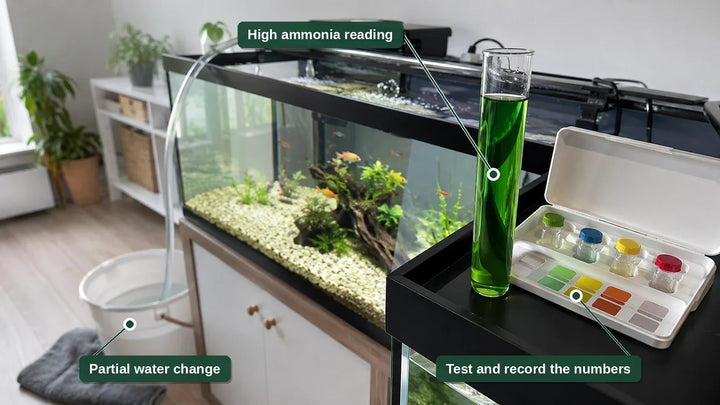
The most common complaint about either product is the same: I dosed it and my ammonia test still reads positive.
That is expected behaviour, and API states the mechanism plainly:
“AMMO LOCK does not remove ammonia; it converts it to a non-toxic form; so, even though ammonia is in a safe, non-toxic form, [the] aquarium will still test positive for ammonia until it is removed by the biological filter.”
— API (Mars Fishcare), official product page
Standard aquarium test kits report total ammonia. A detoxifier changes the form of the ammonia, not the amount of it, so the total the kit reports does not fall. Neither product is failing when this happens — the reading falls when the biological filter processes the ammonia and a water change exports the rest.
How to decide between them
Rather than a winner, here is what the published information actually supports:
- Nitrite or nitrate showing alongside ammonia? Seachem publishes claims covering those compounds; API's AMMO-LOCK page does not.
- Dosing very large volumes routinely? Compare cost per treated gallon at real prices, and weigh the 1-gallon AMMO-LOCK format against buying several smaller Prime bottles.
- Already using one, with results you are happy with? Neither manufacturer publishes evidence that would justify switching on specification grounds alone.
- Whichever you choose: keep testing, keep changing water, and protect the biological filter. Both labels assume you are doing all three.
Frequently asked questions
Is API AMMO-LOCK the same as Seachem Prime?
They are different products from different manufacturers with overlapping but not identical published claims. Both detoxify ammonia and handle chlorine and chloramine in fresh and saltwater; Seachem additionally publishes nitrite and nitrate detoxification, and the two label dose rates differ by a factor of five.
Can I use API AMMO-LOCK and Seachem Prime together?
Neither manufacturer publishes instructions for combining them, and neither label anticipates the other product being in the water. Dose one product according to its own label rather than layering two ammonia treatments; if you want to change products, follow the new product's directions from its own starting point.
Which one removes ammonia from the water?
Neither. Both are described by their manufacturers as detoxifying or converting ammonia. Removal is done by the biological filter and by water changes.
Does Seachem Prime work in saltwater like AMMO-LOCK?
Yes — Seachem describes Prime as a conditioner “for both fresh and saltwater,” and API labels AMMO-LOCK for freshwater and saltwater aquariums.
Sources
- API (Mars Fishcare) — official AMMO-LOCK product page and directions: apifishcare.com/product/ammo-lock
- Seachem — official Prime product page: seachem.com/prime.php
- Seachem support — Prime product description: Info: Seachem Prime product description
- Seachem support — how long Prime stays bound: FAQ: How long does Seachem Prime stay bound?
- Seachem support — how often to dose Prime: FAQ: How often can I dose Seachem Prime?
Working through an ammonia reading right now? Start with High Ammonia in an Aquarium: What to Do. Decided on AMMO-LOCK and need the amount for your tank? Use the API Ammo-Lock dosage chart and calculator, or go to the API AMMO-LOCK 1 Gallon page. More water care in Fish & Aquatics.