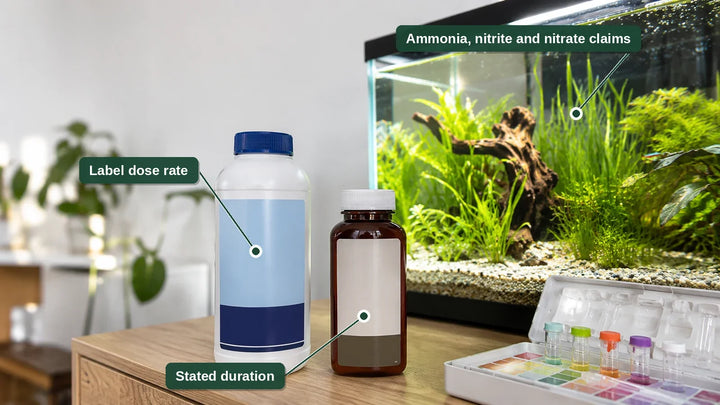
API's label directions for AMMO-LOCK are 5 mL per 10 US gallons of aquarium water, repeated every 2 days until ammonia is not detected. That works out to 0.5 mL per gallon — 27.5 mL for a 55-gallon tank. Use the chart or the calculator below for your own volume.
Last updated 2 September 2026 · Zavyro Team
Disclosure. Zavyro sells API AMMO-LOCK. Every dose figure on this page comes from API's own published label directions, quoted below. Everything we worked out ourselves — per-gallon rates, bottle capacity, kitchen-spoon equivalents — is labelled as calculated, not as a manufacturer claim. We have also included, further down, the strongest published criticism of this category of product.
The label directions, quoted in full
Start here rather than with any chart, including ours. This is what API (Mars Fishcare) publishes:
“Add 5 ml per 10 U.S. gallons (38 L) of aquarium water. Continue to add Ammo-Lock every 2 days until ammonia is not detected.”
— API (Mars Fishcare), official AMMO-LOCK directions
Three things are worth pulling out of that single sentence, because most of the confusion around this product comes from skipping them:
- The dose is written against aquarium water, not against tap water and not against the tank's advertised size.
- It is a repeat dose on a 2-day interval, not a one-off pour.
- The stopping condition is “until ammonia is not detected” — which, as we explain below, is not the same as the test kit reading zero the day after you dose.
API AMMO-LOCK dosage chart by tank size
Every figure in the two right-hand columns is arithmetic on API's 5 mL / 10 gallon rate. It is not a claim by API.
| Tank size (US gal) | Water volume (L) | Dose per treatment | Kitchen equivalent | Doses in a 1-gal bottle |
|---|---|---|---|---|
| 2.5 | 9.5 | 1.25 mL | 0.25 tsp | 3,028 |
| 5 | 18.9 | 2.5 mL | 0.5 tsp | 1,514 |
| 10 | 37.9 | 5 mL (the label unit) | 1 tsp | 757 |
| 15 | 56.8 | 7.5 mL | 1.5 tsp | 504 |
| 20 | 75.7 | 10 mL | 2 tsp | 378 |
| 29 | 109.8 | 14.5 mL | 2.9 tsp | 261 |
| 40 | 151.4 | 20 mL | 1.3 tbsp | 189 |
| 55 | 208.2 | 27.5 mL | 1.8 tbsp | 137 |
| 75 | 283.9 | 37.5 mL | 2.5 tbsp | 100 |
| 90 | 340.7 | 45 mL | 3 tbsp | 84 |
| 125 | 473.2 | 62.5 mL | 4.2 tbsp | 60 |
| 150 | 567.8 | 75 mL | 5 tbsp | 50 |
| 180 | 681.4 | 90 mL | 6 tbsp | 42 |
| 200 | 757.1 | 100 mL | 6.7 tbsp | 37 |
Calculated, not quoted. Litres, per-tank doses, spoon equivalents and bottle capacity are arithmetic on API's published rate of 5 mL per 10 US gallons, using 1 US gallon = 3,785 mL and treating 5 mL as one level teaspoon. Kitchen spoons are a convenience, not a measuring instrument. AMMO-LOCK ships with a dosing cap, and that is what API directs you to measure with; a graduated oral syringe is the better tool when your dose falls between cap markings. Accuracy matters more the smaller your tank is.
Calculator: your tank, your dose, your bottle
Enter the water volume of your aquarium. The calculator returns the label dose for one treatment, and how far a 1-gallon bottle goes at that dose.
Dose rate from API's published directions. Bottle capacity and course counts are calculated by Zavyro and rounded down.
How far a 1-gallon bottle actually goes
This is the figure nobody publishes, and it is the one that decides whether the large format makes sense for you. A US gallon is 3,785 mL. At the label rate, one bottle covers 7,570 gallons of aquarium water — spread across as many treatments as your tank needs.
In practice: a 29-gallon community tank takes 14.5 mL per dose, so a gallon holds around 261 doses, or roughly 65 full seven-day courses. A 180-gallon tank takes 90 mL per dose, which is about 42 doses or 10 courses. Below roughly 40 gallons, a 1-gallon container is far more product than a single tank will use before you would want to question how it has been stored; above 75 gallons, or across several tanks, it starts to be the sensible unit. That is the honest case for the 1-gallon AMMO-LOCK format: fish rooms, breeders, shops, ponds and multi-tank setups — not a single 20-gallon tank.
Dose the water, not the label on the tank
A “55-gallon” tank does not hold 55 gallons of water. Substrate, rock, hardscape, large decorations and the gap between the waterline and the rim all displace volume, and every one of them makes your real figure smaller than the number on the box. Dosing against the advertised size therefore means dosing slightly high.
API's directions are written against “aquarium water,” so the accurate input is the water you actually put in. If you have never measured it, the reliable method is to note how many measured buckets or jugs it took to fill the tank the last time you set it up, or to measure the internal length × width × actual water depth and convert. We are deliberately not publishing a rule-of-thumb percentage to subtract: displacement depends entirely on how much substrate and hardscape you have, and a made-up percentage would be a worse input than your own measurement.
The every-2-days schedule, and where it stops
AMMO-LOCK is not a single corrective dose. The label sets a repeat interval and a stopping condition, and API publishes what to do if the problem outlasts a week:
“If after 7 days, ammonia is still present, perform a partial water change, service your biological filter and reduce feeding.”
— API (Mars Fishcare), official AMMO-LOCK directions
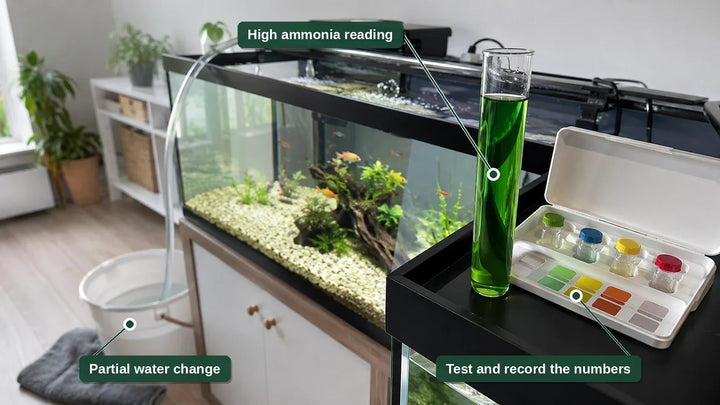
Read that as the manufacturer's own limit on its product. After a week, API stops telling you to add more and starts telling you to fix the tank: export the ammonia with a water change, restore the filter, and stop feeding the problem. API frames the product the same way elsewhere: what to reach for when you cannot do a partial water change straight away, until you can. A detoxifier is a holding measure that buys the biological filter time; it is not a substitute for the filter, and no dosing schedule on this page changes that.
Your test will still read ammonia. That is expected.
The single most common report about this product is that the ammonia test has not moved after dosing. API states the mechanism plainly, and it is worth reading before you conclude the bottle is defective:
“AMMO LOCK does not remove ammonia; it converts it to a non-toxic form; so, even though ammonia is in a safe, non-toxic form, [the] aquarium will still test positive for ammonia until it is removed by the biological filter.”
— API (Mars Fishcare), official product page
A standard hobby test kit reports total ammonia. If a product changes the form of the ammonia without removing it, the total the kit reports does not fall. This also creates a practical trap: because the reading stays up, people dose again ahead of schedule, then again, chasing a number that was never going to drop on its own. Keep to the 2-day interval and change water. If you are in the middle of a reading right now, start with High Ammonia in an Aquarium: What to Do, which covers the whole sequence rather than just the dose.
The objection: does detoxifying actually work?
A dosing page that ignores this question is a sales page. So, plainly: the claim that ammonia detoxifiers meaningfully reduce toxic free ammonia is disputed, and the dispute is not a fringe one.
Aquarium Science, an independent hobby-science site that publishes its own bench tests, tested products in this category using free-ammonia indicator dots on water at 5 ppm total ammonia and pH 8.0, and reported that the free-ammonia reading did not change after treatment. Its conclusion about the category is blunt — that there are “NO chemicals which will neutralize the ammonia” — and it argues that any conversion of ammonia to ammonium observed after dosing is ordinary water chemistry rather than an effect of the product. Community sentiment on Reddit and the larger fishkeeping forums leans the same way, particularly against using a detoxifier while cycling a tank.
Where that leaves the dose on this page. Neither API nor its critics have published a head-to-head trial that settles the question, and we have not run one. What we can tell you without qualification is what the manufacturer's directions say, and what those directions work out to for your tank — which is what this page is for. What no one disputes, including API's own label, is the part that actually fixes an ammonia reading: change water, protect and feed the biological filter, and cut feeding. If you only do one thing after reading this, do that. For how AMMO-LOCK's published claims compare with the alternative most often recommended in those same threads, see API AMMO-LOCK vs Seachem Prime.
Frequently asked questions
How much API Ammo-Lock per gallon?
0.5 mL per US gallon of aquarium water, which is API's published rate of 5 mL per 10 gallons expressed per gallon. For a 20-gallon tank that is 10 mL; for a 55-gallon tank, 27.5 mL.
How often can you use API Ammo-Lock?
API's directions say to add it every 2 days until ammonia is not detected. The label also sets a 7-day checkpoint: if ammonia is still present after a week, API directs you to perform a partial water change, service the filter and reduce feeding rather than to keep dosing indefinitely.
Can you overdose API Ammo-Lock?
API publishes a single dose rate and a dosing interval, and does not publish a multiplied emergency dose or a stated maximum. Because no higher rate is published, we will not invent one: dose to the label rate rather than above it, and measure with the bottle's dosing cap or a graduated syringe rather than estimating by eye.
Why is my ammonia still high after adding Ammo-Lock?
Because the product does not remove ammonia. API states that it converts ammonia to a non-toxic form and that the aquarium “will still test positive for ammonia until it is removed by the biological filter.” Standard test kits measure total ammonia, so the number stays up until the filter processes it and a water change exports the rest.
How many doses are in a 1-gallon bottle of Ammo-Lock?
It depends on your tank. One US gallon is 3,785 mL, which at the label rate treats 7,570 gallons of aquarium water in total — about 757 doses for a 10-gallon tank, 137 for a 55-gallon, or 42 for a 180-gallon. Use the calculator above for your own volume.
Do I still need a water change if I use Ammo-Lock?
Yes. API describes AMMO-LOCK as what to use when you cannot perform a partial water change right away, and its own 7-day label instruction is to change water rather than to keep dosing. A detoxifier holds a reading; a water change removes it.
Does the dose change for saltwater?
API labels AMMO-LOCK for freshwater and saltwater aquariums and publishes one rate: 5 mL per 10 gallons of aquarium water. No separate saltwater rate is published.
Sources
- API (Mars Fishcare) — official AMMO-LOCK product page and label directions, source of every dose figure quoted here: apifishcare.com/product/ammo-lock
- Aquarium Science — independent bench testing of ammonia detoxifying products: aquariumscience.org, 5.5.3.1 Ammonia Detoxifying
- Conversions used: 1 US gallon = 3,785.41 mL = 3.785 L; 1 level teaspoon treated as 5 mL; 1 tablespoon = 3 teaspoons. Per-tank doses, bottle capacity and course counts calculated by Zavyro from API's published rate.
Next: if your reading has not moved, read High Ammonia in an Aquarium: What to Do. If you are choosing between products, read API AMMO-LOCK vs Seachem Prime. The product itself is here: API AMMO-LOCK 1 Gallon, and the rest of our water care range is in Fish & Aquatics.